Science Pedagogical Practices
Vision of the Science Teacher I Want to Be
To me, science is a form of curiosity, and a way of seeing and understanding the world around us. Science is not simply facts, but a way of asking questions, testing ideas, and finding understanding based on what is observed. As I believe that every child is born a scientist, and is constantly exploring phenonmena that they don't necessarily understand, I think its important to not only allow exploration during a science period, but throughout the day using observation, wonder and questioning. I hope to bring this type of curiosity inspired and engagement-filled learning to my science classroom and lesson!
In "A Question I Couldn’t Answer" (Ondricek & Nixon, 2023), the teacher experiences a moment of uncertainty when an unexpected question arose from a student. This reading helped me see that not having an answer right away isn't a failure moment as an educator but a learning moment for everyone in the room. Through this reading and experiences in enacting lessons, I have learnt that a part of teaching and doing science is about uncertainty. Knowing this, I hope to model that not knowing something, and aksing questions about it isn't seen as a weakness but as resilience and curiosity.

Ambitious Science Teaching. (2015). Models and Modeling: An Introduction. https://ambitiousscienceteaching.org/
Ondricek, B., Nixon, R.S. (2023). Case and Commentary : A Question I Couldn’t Answer. In: Jeong, S., Bryan, L.A., Tippins, D.J., Sexton, C.M. (eds) Navigating Elementary Science Teaching and Learning. Springer Texts in Education. Springer, Cham.

Supporting Students in Learning Science
Goals for Students Learning Science
Modeling Scientific Concepts:
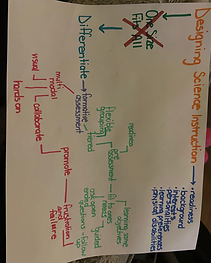
Support 1: Providing multimodal opportunities using learning stations
-
Stations can include:
-
Drawing Diagrams
-
Use of Technological Materials (apps, websites, etc.)
-
Hands-On (clay, games, etc.)
-
Support 2: Using modeling to revise thinking and formulate explanations
-
Before the experiment, students can draw their initial ideas about the phenomena.
-
After the experiment has been conducted, students can revise and make changes to their models and see what knowledge they have gained about a certain concept.

Understanding and Investigating Scientific Ideas:
Support 1: Wonder Wall
-
When students have a scientific question or idea about real-world phenomena, they can add their ideas using sticky notes to the designated "Wonder Wall.
-
Using these big questions, I can plan engaging lessons that help students discover the answers!
Support 2: Sentence Starters to Guide Inquiry
-
For students who needing some guided entry points to thinking scientifically, I would provide them with sentence starters.
-
Examples: "What happens when we change ____?" or "Why does ____ happen?"
-
This guided inquiry can help students turn their big ideas into testable ones.
Modeling Scientific Concepts:
-
I want my students to learn and be able to represent scientific ideas using a variety of models.
-
Examples: Diagrams, drawings, mind maps, use of technology, charts, explanatory models, etc.


Understanding and Investigating Scientific Ideas:
-
I want my students to learn and be able to ask scientific-based questions about real-world phenomena that can be tested and investigated.
-
Examples: Why do things float or sink?, Why and how does matter change state?, etc.