Science Lesson Plan I
Here you will find an overview and example of a 3E science lesson plan that was produced and enacted!
Summary of 3E Lesson Plan I
Topic
Driving Question
-
If dinosaurs have been extinct for millions of years, how do we know what kinds of food they ate (carnivore, omnivore, herbivore) based on their fossil remains?
Grade
-
Oriented to Fourth Grade students (Cycle 2)
Instructional Goals
Head Goals
-
Students will be able to observe different forms of dinosaur teeth, feet and claws, and infer what type of consumers dinosaurs were based on the shapes, sizes and other physical characteristics they observe from the dinosaur teeth.
-
They will be able to identify key terms like carnivores, herbivores, and omnivores and categorize the similar traits of each type of consumer.
Hand Goals
-
Students will be able to use moulds to imprint the dinosaur teeth, feet and claws, and be able to compare the key differences between one fossil and the next and be able to infer what type of consumer the dinosaurs were based on their shape and size.
-
They will also given play doh with which they can mould the fossils and compare them with the moulds that are given to see the key similarities between the moulds that were given to them and the Play-Doh moulds that they can create themselves.
-
Practice their investigative and science process skills by being able to make claims about the different teeth, feet and claws that they observe and from these claims, be able to infer about the type of consumers those dinosaurs once were.

RedPath Museum Visit - Dinosaur Exhibit
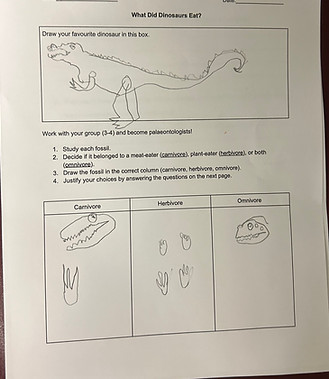
Example work from a 1st grade student
Heart Goals
-
Students may demonstrate perspective by bringing the topic back to their own teeth, hands and feet and what shapes and sizes they observe that humans have and how it may link to the concept of evolution.
-
They may display empathy for the dinosaurs that have gone extinct and know that we are also connected with dinosaurs with the concept of evolution because we also have similar consumer traits (we have omnivore-like teeth).
3E Phases
Engage
-
Students were asked what they knew about dinosaurs. If students mentioned any key terms (extinction, fossils, paleontologist, herbivore, carnivore, omnivore, etc.) then it was written for later reference.
-
Each student was provided with a worksheet to draw a dinosaur based on toy dinosaur models that were around the classroom. A discussion about what their drawing dinosaur ate followed this activity. Students begin to infer what types of consumers dinosaurs may have been and traits that relate to them.
Explore
-
Individually or in groups, students were given Play-Doh and toy dinosaurs to create their own fossils of the toy's feet and teeth to further analyze their hypothesis'.
-
Students were handed pre-made fossils to observe and categorize which dinosaur was what type of consumer. Students will get to see what it is like to be a paleontologist. They will use the evidence and observations that they accumulate to infer about the dinosaur’s possible diets.
Analysis of 3E Lesson Plan I
Reasoning Behind Pedagogical Choices
-
This 3E lesson plan on dinosaur fossils and their diets had its design focus on allowing students to delve into a realm that many elementary-aged students are intrigued by.
-
This lesson focused on having students engage in curiosity-inspiring hands-on activities to help them foster their love of learning and understanding science.
Practices of High Quality Teaching
-
This lesson incorporated lots of active learning opportunities as I believe it is incredibly important for students to handle material hands-on, to fully grasp the concept they are exploring, and to cater to all learning types.
-
Scaffolding was clearly incorporated into the lesson as we wanted students with little to no prior knowledge of the topic to be able to participate. Started with simple key terms that would be discussed and ended the lesson with a discussion of more complex ideas.
-
This lesson allowed for all students no matter their prior dinosaur knowledge or experience with science to engage and learn in this fossil discovery simulation.
Explain
-
Students were asked questions and let them finish answering why they think some teeth are omnivore teeth while others are herbivore and carnivore teeth as well as why (what evidence) they think the dinosaur claws and feet belong to the omnivore, herbivore and carnivore group that they choose.
-
Discussion of how sharp teeth belong to carnivores, how non-sharp teeth belong to herbivores how partially sharp teeth and partially non-sharp teeth belong to omnivores, why sharp claws belong to carnivores, why dull claws belong to herbivores and what omnivore claws could look like will be covered
-
The discussion was guided by the students and were pressed on for detailed responses with clear evidence of their thinking.

Example work from a 1st grade student
Link to the Full Lesson Plan!

